Destroyed the engine with excessive leaning?

MountainDude

Cleared for Takeoff
PoA Supporter
Joined
Jul 29, 2011
Messages
1,466
Display Name
MountainDude
Home Airfield
KPDX
Someone posted:
- Flying club member accidentally destroyed engine by running the temps too hot during their long flight.
- The A&P says the damage caused from long periods of excessive leaning and the flight data reflects dangerously high EGT's during that one members flight that would cause such damage.

Can someone explain to me what is excessive leaning? Anything below 50-100 degrees LOP is going to stop detonating (my understanding), so you cannot lean any more.
Also, how can a lean engine on a long flight overheat and be destroyed? I thought leaning was better for the engine.
 
My guess is they were still ROP (not LOP) and probably at peak or close to it which depending on conditions/power setting means they were in the proverbial "red fin" which is bad for prolonged operation.
 
I assume what they mean is a combination of power and mixture settings that resulted in exceeding max oil temp or CHT for an extended period.

EGT cannot be too high by itself. Lycoming instructions for max fuel economy are set power below 75% and lean to peak EGT. That is why your aircraft has no EGT redline. It is the effect on CHT and oil temp that must be monitored.
 
Last edited:
Can't be both.
OK poor wording on my part. I think excessive leaning in this case meant to less than 25* ROP or to Peak which maximizes ICP, but not LOP. My understanding is that high power settings (above 65%) in this region (the "red fin"), for prolonged operation can have catastrophic effects.
 
Last edited:
Wide open throttle (max MP), lean to max EGT, keep altitude on the lower side so % power is >65-70%. Basically “full rental power”.

Blaming the mortal event on the last flight is probably easy to do even though the damage was likely built up over time by that renter and/or others over a period…unless many hours of previous flight data were reviewed too?
 
I'd try to get more information from the other member about how the flight in question was operated (in as friendly a way as possible).
 
What was the specific damage and what were the CHT's? That's far more informative than EGT's.
 
This is the only info available from the poster
 

Attachments

  • Screenshot 2026-07-10 at 8.55.14 AM.png
    Screenshot 2026-07-10 at 8.55.14 AM.png
    76.7 KB · Views: 80
  • Screenshot 2026-07-10 at 8.55.02 AM.png
    Screenshot 2026-07-10 at 8.55.02 AM.png
    112.8 KB · Views: 80
This is the only info available from the poster
So not your plane or your club. I'd really challenge that A&P. "Destroyed" is basically meaningless. High EGT is also kind of a meaningless number as well. The only thing that can destroy an engine in one flight from how you run the engine is detonation. That would mean running at peak or slight rich of peak AND at a very high power setting. Detonation damage is pretty obvious on the piston surface.

Lot's of good articles/posts on running LOP. Done properly, it's pretty benign. The red box or fin that folks talk about is where there is a risk of detonation.
 
This is the only info available from the poster
I meant info from the person who flew it. Didn't realize it was an anonymous SM post. Yes, it's possible ruin any engine via abuse and negligence. I know of a C152 engine that got ruined from ground idling too long on a hot day. Not enough info in this particular case to determine how or why this occurred.
 
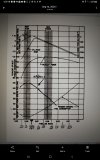
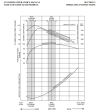
There may be a misunderstanding here about what leaning actually is. See the attached graph. When you takeoff at full power and full rich the fuel-air ratio is somewhere between 100 - 200 °F ROP EGT, or about .075-.088:1 FAR, or 13.33 - 11.36:1 AFR Air fuel ratio. At these fuel ratios the CHT Cylinder Head Temperatures are at or below maximum designed temperature tolerance, as indicated on the graph as being at or below zero degrees CHT, the change in temperature compared to maximum designed tolerance. As you climb the air thins and the fuel air ratio gets richer. This is where you lean during the climb to maintain about the same EGT as you had at the start of the climb when the mixture was set full rich at takeoff.

As you lean from full rich leaner than 100°F ROP the flame propagation time speeds up, and engine internal stress increases, and the CHT increases along with it above the maximum designed tolerance. This can be avoided by reducing power and further leaning to Lean of Peak operations, or by increasing richness more than 100°F ROP EGT. Running LOP delays flame propagation time faster than running ROP, but running 10-75°F ROP, especially at higher loads, is a good way to kill an engine in a hurry as indicated by the CHT curve on the graph.

Leaning to less than 100°F of Peak EGT while running Rich of Peak and not reducing power is the worst place to operate your engine. Cruise Power must be reduced below 75% and the hottest CHT should be monitored to keep it well below 400°F during cruise. You can run ROP or LOP but CHT must be kept below the danger zone at all times during cruise. You can get better fuel economy running LOP if your engine can run there smoothly, but you can also run ROP if that suits you.

You should read RED BOX RED FIN by Mike Bush to get a better understanding of this concept.

Hope this helps. Pete
 

Attachments

  • Screenshot_20260710-160933_Photos.jpg
    Screenshot_20260710-160933_Photos.jpg
    670.3 KB · Views: 23
Last edited:
EGT doesn't damage engines. CHT does, and exhaust valves opening while the mixture is still burning (retarded timing or slow burning mixture) torches the valve seats. But hot gasses do no damage.

The indicated value on an EGT gauge means absolutely nothing. EGT probes are not looking at a continuous exhaust gas stream (they're located 2-4" from the exhaust port on the cylinder head on their respective cylinders). The probe sees hot gasses for 25% of the 4-stroke cycle, then sees nothing for the remainder of the 4-stroke cycle. Because the probe cannot react instantaneously at the rate it's being exposed to hot gasses, it ends up averaging on some arbitrary value.

Lean mixtures take longer to burn than stoichiometric mixtures do. If you're excessively lean, there is the chance your mixture is still burning at the time the exhaust valve opens, exposing your exhaust valve seats to flame. It is this that torches the seats. Cars have no issue with very lean mixtures because they have computer controlled timing advance. The advance lights the mixture earlier in the cycle so that peak cylinder pressure is made at the same point after top dead center (usually around 17 degrees is considered ideal). This is one reason why people get SureFly and ElectroAir ignitions in their planes. They have electronic timing advance, which allows them to run leaner than they could with a fixed timing magneto without torching their valve seats, which amounts to fuel savings.
 
Last edited:
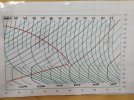
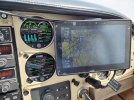
This is a photograph of the Red Fin Fuel and Air chart I use to lean my engine precisely every time I fly. The engine monitor photograph shows 21.0 Manifold Pressure, 2580 RPM, 8.4 GPH and 374°F CHT on the hottest cylinder head. 21 + 25.8 is MR# 46.8, or about 47. Follow the 47 MR curve down to intersect with the 8.4 GPH curve and you see I am running about 65°F LOP and producing about 63% power, that on my engine is 126 HP. This is the maximum amount of power I can make on 8.4 GPH, so I am getting the best fuel economy possible. I am well outside of the Red Fin and running well below 400°F on the hottest cylinder head.

To me, this is what leaning is all about.
 

Attachments

  • IMG_20240714_084603093.jpg
    IMG_20240714_084603093.jpg
    1.6 MB · Views: 41
  • IMG_20240721_150703952_HDR.jpg
    IMG_20240721_150703952_HDR.jpg
    1.8 MB · Views: 38
Last edited:
If you really want to understand what is going on inside your cylinders during combustion, I highly recommend the online Advanced Pilot Seminars course offered by GAMI. They have thousands of hours of engine data in a fully instrumented test cell. Running too lean didn’t damage the engine…not running lean enough did. If you run lean enough to keep CHT’s under control (under 380f), your engine will be happy. This assumes that your engine can run LOP without too much shakin’ goin’ on. My Lyc powered 182 couldn’t. My Coni powered 210 with a crappy 1.6gph GAMI spread can. I lose about 8kts at 70-72% power and get 168-170kts on 13.6gph near full fuel and 900lbs in the cabin. Borescope of the cylinders looks great. I’m a believer.
 
This is a photograph of the Red Fin Fuel and Air chart I use to lean my engine precisely every time I fly. The engine monitor photograph shows 21.0 Manifold Pressure, 2580 RPM, 8.4 GPH and 374°F CHT on the hottest cylinder head. 21 + 25.8 is MR# 46.8, or about 47. Follow the 47 MR curve down to intersect with the 8.4 GPH curve and you see I am running about 65°F LOP and producing about 63% power, that on my engine is 126 HP. This is the maximum amount of power I can make on 8.4 GPH, so I am getting the best fuel economy possible. I am well outside of the Red Fin and running well below 400°F on the hottest cylinder head.

To me, this is what leaning is all about.
Mike Busch has repeatedly stated that below 70-75% power, there is zero chance of damaging an engine via mixture setting. Basically anywhere is fair game. It's when you get to the 75% power and above that mixture setting becomes critical.
 
Mike Busch has repeatedly stated that below 70-75% power, there is zero chance of damaging an engine via mixture setting. Basically anywhere is fair game. It's when you get to the 75% power and above that mixture setting becomes critical.
I disagree with you. Engine damage can occur at 70--75% power. In his own paper Mike Bush shows the Red Box at 75%, then smaller at 65%, and is gone at 60%. The Red Box has disappeared at or below 60%, not 70-75%. The tip of the Red Fin is shown at about 10°F ROP at 61%. Being aware that the potential for damage occurs at 61%, 65%, 70% or 75% means monitoring CHT becomes more important at those power levels.

All you have to do is keep CHTs well below 400°F during cruise and your engine will be protected. Every engine installation is slightly different and some engines require more vigilance than others. We as pilots should understand how to operate our engines without burning them up prematurely. That is the goal we should all strive for.

PS: I have also taken the Advanced Pilot Course from GAMI. It is very good and I learned a lot. I wanted a more precise way of power management and leaning and that is what led me to draw the RFFA graph I use in my airplane. (post #17) I spent over a year creating it and another year refining it. After 5 years I now have the ability to create an RFFA graph for almost every engine available, I am even applying it to a marine engine.

One Miracle at a time!
 
Last edited:
All you have to do is keep CHTs well below 400°F during cruise and your engine will be protected.
My KISS mentality makes me think that this is really all it's about on both sides of peak. When I read, "Destroyed the engine with excessive leaning?" I see "Destroyed the engine with improper leaning?" or "Destroyed the engine by not monitoring its parameters?" We don't know from the text what they were leaning, how they were leaning, or even if they had an engine monitor.
 
I disagree with you. Engine damage can occur at 70--75% power. In his own paper Mike Bush shows the Red Box at 75%, then smaller at 65%, and is gone at 60%. The Red Box has disappeared at or below 60%, not 70-75%. The tip of the Red Fin is shown at about 10°F ROP at 61%. Being aware that the potential for damage occurs at 61%, 65%, 70% or 75% means monitoring CHT becomes more important at those power levels.

Red box is based on 400 CHT, which is Lycoming long term operating recommendation for maximum longevity. Red line where damage may occur is 450. You may hit 400 at power settings between 65 and 75%, but you will not hit 450. Above 75% you are in danger of exceeding 450 redline. Hence Lycoming guidance not to lean above 75% power.

All you have to do is keep CHTs well below 400°F during cruise and your engine will be protected.

Does not need to be "well below," just at or below. There is no need to treat 400 as a red line, when it is not.

Mike Busch has repeatedly stated

It mystifies me why we all quote Mike Busch as the authority and not Lycoming and Continental, who have serviced and warrantied far more engines than Busch will see in his lifetime.
 
It mystifies me why we all quote Mike Busch as the authority and not Lycoming and Continental, who have serviced and warrantied far more engines than Busch will see in his lifetime.
I agree. Busch is a maintenance guy. Anything he says WRT engine operating parameters is either anecdotal or second hand. I'm much more inclined to listen to Lycoming, Continental, and/or other researchers who do long term work with these engines on the dyno.
 
It mystifies me why we all quote Mike Busch as the authority and not Lycoming and Continental, who have serviced and warrantied far more engines than Busch will see in his lifetime.
The uncynical view is that times and information change.

The neutral (at least in my mind) view is that even the engine manufacturers have changed their tunes along the way. And while some of those might be reflected in the engine manual, not all are transferred to the airframe POH. The first of the Busch videos linked starts off discussing with the 2011 Lycoming Service Instruction calling for leaning for all ground operations and during climb. The checklists in the last Cessna 172 NAVIII POH I've looked at don't talk about ground leaning, make no mention of leaning for high D-Alt takeoffs and, while it now talks about leaning for the climb above 3,000 feet, it refers to the altitude as pressure altitude rater than density altitude. A related practical reason is that pilots typically don't read engine manuals and service instructions. Busch becomes a centralized resource who explains rather than simple commands.

The cynical view is that they continue to recommend leaning to Red Box figures because that results in more engine replacements.
 
I agree. Busch is a maintenance guy. Anything he says WRT engine operating parameters is either anecdotal or second hand. I'm much more inclined to listen to Lycoming, Continental, and/or other researchers who do long term work with these engines on the dyno.

At Oshkosh you can actually talk to the Lycosaur and Conti engineers directly at their presentations. Always hilarious to watch a few Busch followers corner them afterwards to argue about LOP. The engineers are not fans.
 
The uncynical view is that times and information change.

Right, and the Lycoming engineers are apparently stuck in a time machine, unable to access modern information.

The neutral (at least in my mind) view is that even the engine manufacturers have changed their tunes along the way. And while some of those might be reflected in the engine manual, not all are transferred to the airframe POH.

Entirely fair, which is why I advocate knowing and following the engine operators manual.

The cynical view is that they continue to recommend leaning to Red Box figures because that results in more engine replacements.

That is the idiotic view. Their primary business motivation is to minimize warranty claims. The engineers will tell you that face to face.
 
Another explanation for the squishiness of max-CHT recommendations might be that strength-of-cylinder-material vs temperature is a curve and not a step function.
 
Last edited:
I "chase" egt in climb. Monitor cht. Level off and lean to peak. Leaning 50 degrees lean of peak is a very marginal fuel savings.

Flying a naturally aspirated engine you can't get the egt hot enough to damage. You can nuke cylinders if you're leaning in climb.

Now if the plane in question is turbo, then that changes the dynamic.
 
Red box is based on 400 CHT, which is Lycoming long term operating recommendation for maximum longevity. Red line where damage may occur is 450
Actually, at least on my Lycoming O-360, per Lycoming:

“For maximum service life, cylinder head temperatures should be maintained below 435°F (224°C) during high performance cruise operation and below 400°F (205°C) for economy cruise powers.” (pg 38) and max CHT for Normal Rated, Performance Cruise, and Economy Cruise is 500° (pg 44).

Not sure where 450 came from. And I’m not sure why high performance cruise has a higher figure.

That’s Lycoming, with sodium valves. Continental is lower.
 
Right, and the Lycoming engineers are apparently stuck in a time machine, unable to access modern information.
What they say in their Service Instructions/Letters/Bulletins sometimes differs from what we see in their Operator Manuals. For instance, they recommend 50° ROP for an IO-360, and yet the manual's chart shows something quite different:

1783887017228.png

We see there, on the left, that best economy is coming lean of peak EGT.

Somewhere, in a Lycoming publication. I read that you can do anything you want with the mixture with the power at 65% or less. They used to say 75% or less. Can't find it now. I think they say "no lean-of-peak" due to the risk of engine damage and warranty hassles and lawsuits. Too many pilots cannot be trusted to consult the POH/AFM to see where 65% power is, for example. Heck, they cannot even be trusted to pull the carb heat when the engine starts losing power. So, Lycoming now has this available: https://www.lycoming.com/engines/ie2 and I bet it will run LOP because it doesn't have to rely on the pilot to keep things together.
 
Let's assume that you flew a Lycoming 360 for about 2 hours at 9500' and at 2600 rpms and did not lean and CHTs at 350. Would that damage the engine? Asking for a friend.
 
Let's assume that you flew a Lycoming 360 for about 2 hours at 9500' and at 2600 rpms and did not lean and CHTs at 350. Would that damage the engine? Asking for a friend.
It will foul those spark plugs and you'll be getting large and shaky mag drops and poor performance. It will carbon up the piston head and cylinder head, and that carbon glows and sets off the mixture prematurely (before the spark) and you get detonation and pressure spikes and engine damage. The carbon breaks off and scores the cylinder walls. The exhaust valve stems carbon up and the valves might start sticking.

Pilot training is important. Did your friend get any engine management training at all?
 
Back
Top