Gami gas has arrived...

It depends on the 100LL. Some do contain a significant volume of xylenes. See post 145 in this thread.
I saw that... but I don't think you can actually meet the D910 avgas spec with 15% xylenes as indicated there... you'll be too heavy on distillation. Also note that Shell doesn't produce 100LL in the US. :) They exchange for avgas with others, and import a small amount from Europe.

But GAMI's fuel is quantitatively different... 30%+ xylenes. As the old adage goes, the difference between a medicine and a poison is the dose! In Australia, they've run gasolines that are 50% aromatics, and there are challenges... All that said, these are teething pains... GAMI's a bunch of smart folks, and they're working on a mitigation plan... I'm optimistic.

Paul
 
the FAA doesn't seem interested in preventing crises before they occur.
To be fair, that's the result of the management model. When's the last time Congress commended a regulator for anticipating a problem and preventing it before it occurred? Versus Congress calling bureaucrats on the carpet to decry "needless" spending. The reward system in government doesn't do much for those who prevent problems; it is set up to reward heroes, after the crisis surfaces.

Paul
 
I saw that... but I don't think you can actually meet the D910 avgas spec with 15% xylenes as indicated there... you'll be too heavy on distillation. Also note that Shell doesn't produce 100LL in the US. :) They exchange for avgas with others, and import a small amount from Europe.

But GAMI's fuel is quantitatively different... 30%+ xylenes. As the old adage goes, the difference between a medicine and a poison is the dose! In Australia, they've run gasolines that are 50% aromatics, and there are challenges... All that said, these are teething pains... GAMI's a bunch of smart folks, and they're working on a mitigation plan... I'm optimistic.

Paul
Please explain "...too heavy on distillation". I'm taking it to mean the fuel is distilled to something close to its final form. Few gasolines are simply distilled anymore, not since around WW2. They are all formulated now.
BP (North American SDS) lists xylene, but not a quantity:
"Gasoline is a complex mixture of hydrocarbons and contains benzene (typically no more than 2 volume%), toluene, and xylene."

As for Shell, their product list for the USA is here: https://www.epc.shell.com/Product/ProductList
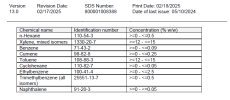
Most of them do contain xylene as per my posting earlier (# 145)- I think only one of the items on their list does not. If it is in a USA product catalog, it is reasonable to assume the product is sold and used in the USA.
The link for shell seems to want you to go another page first: https://www.epc.shell.com/home/HomeSetup?inLang=EN
Select "United States" for the market, "Shell Fuels" for the Business type, and search for "100LL" and you'll get a list of 7 products sold in the USA.

These companies claim to meet the D910 specification.
 
Last edited:
This statement isn't true See below.
View attachment 139725


Sure. With a gas chromatogram. Or measuring the density of the mixture. Not as easily done as with 100 LL.


Like infinite? Water and ethanol are 100% miscible.


Until you get to the point where there is too much water in the ethanol to allow it to burn. You'll have loss of power prior to that point, just because there is less ethanol to burn. the loss of power will probably stop the engine prior to that point, but I don't know what that point is. But logically, the mixture will be too lean to run as ethanol is replaced with water.


AGE-85 != pure ethanol. Use one term or the other. Pure ethanol was used by Baylor.
Besides- Cessna says NOT to use it.


I did intermix AGE-85 and 100% ethanol as it is my understanding that you really cannot get 100% ethanol. Also ethanol must be denatured to 95% because, you know, BATFE.. A quick google shows 1 gallon of 100% ethanol (lab grade) is ~ $40/gal. 95% denatured ethanol is $25 automotive E85 is < $3/gallon. I do believe the current ethanol fuel in evaluation is AGE-85 but I cannot find a price.

Again, water in ethanol is not a huge deal. If you do surpass the 4% by volume the engine will run lean. The math is in a 25 gallon fuel cell, you need OVER 1 gallon of water to dilute to 4%. If you let water in a 100LL tank and it reaches the engine it stops.

Cessna doesn't make engines so why are they chiming in? The TCDS for their AC says to run 100LL. Without an STC you cannot run MOGAS or Ethanol. Cessna allows 91UL in certain NEW aircraft. 91UL is 91 octane unleaded.

With the proper modifications ethanol has been proven to work fine.
 
That's why Cessna says don't use it. Pre 86 aircraft may and probably do have seals and o rings not comparable with ethanol. Think fuel selector valves, primer seals etc. and I could see an aluminum tube hooked to a steel or brass fitting in the presence of ethanol having a greater galvanic corrosion probability.
 
I did intermix AGE-85 and 100% ethanol as it is my understanding that you really cannot get 100% ethanol. Also ethanol must be denatured to 95% because, you know, BATFE.. A quick google shows 1 gallon of 100% ethanol (lab grade) is ~ $40/gal. 95% denatured ethanol is $25 automotive E85 is < $3/gallon. I do believe the current ethanol fuel in evaluation is AGE-85 but I cannot find a price.

Again, water in ethanol is not a huge deal. If you do surpass the 4% by volume the engine will run lean. The math is in a 25 gallon fuel cell, you need OVER 1 gallon of water to dilute to 4%. If you let water in a 100LL tank and it reaches the engine it stops.

Cessna doesn't make engines so why are they chiming in? The TCDS for their AC says to run 100LL. Without an STC you cannot run MOGAS or Ethanol. Cessna allows 91UL in certain NEW aircraft. 91UL is 91 octane unleaded.

With the proper modifications ethanol has been proven to work fine.
So how can you easily check to make sure your plane hasn't gone over that 4%. Being slightly lean could bring you into the "red box" during high power operations.

Large scale, ethanol isn't an option. You'd be asking every aircraft in the fleet to make 5 figure alterations to run the stuff safely.

Cessna is chiming in due to material compatibility issues. The same gripes they have with gami gas. Ethanol in the presence of water destroys aluminum. How do you combat that with aluminum fuel tanks and fuel lines and galvanic corrosion?

Id consider hydrogen or propane a more viable solution than Ethanol.
 
Last edited:
I did intermix AGE-85 and 100% ethanol as it is my understanding that you really cannot get 100% ethanol. Also ethanol must be denatured to 95% because, you know, BATFE.. A quick google shows 1 gallon of 100% ethanol (lab grade) is ~ $40/gal. 95% denatured ethanol is $25 automotive E85 is < $3/gallon. I do believe the current ethanol fuel in evaluation is AGE-85 but I cannot find a price.

Again, water in ethanol is not a huge deal. If you do surpass the 4% by volume the engine will run lean. The math is in a 25 gallon fuel cell, you need OVER 1 gallon of water to dilute to 4%. If you let water in a 100LL tank and it reaches the engine it stops.

Cessna doesn't make engines so why are they chiming in? The TCDS for their AC says to run 100LL. Without an STC you cannot run MOGAS or Ethanol. Cessna allows 91UL in certain NEW aircraft. 91UL is 91 octane unleaded.

With the proper modifications ethanol has been proven to work fine.
Wow! So much incorrect information here.
I have 20 liters of 100% ethanol in my lab- I just saw it yesterday. The Baylor study used 100% ethanol. If there was anything else used, why do you think they wouldn't say it? It is distilled from a ternary mixture of water, ethanol, and benzene (I think- it has been a long time). The mixture forms an azeotropic mixture allowing the ethanol to be distilled.

Please cite the ruling that says ethanol must be denatured to 95% "...because, you know, BATFE." The reason simple water-ethanol mixtures are 95% EtOH after distillation is they form an azeotrope in those proportions that has a minimum boiling point. Nothing to do any man-made laws. Many liquor stores sell this under the name "Everclear". The denatured ethanol from your local home supply store probably contains methanol as a denaturant. Ethyl acetate, kerosene, isopropanol, acetone, and various other ketones are used as denaturants. A denaturant just needs to taste foul and be uneconomical to remove the denaturants. Here's an example of EtOH with just 1% denaturant (methyl ethyl ketone): https://www.sigmaaldrich.com/US/en/...xnd-BBYhXHboEf97KLeNjwGGdAEXKs7WYuLbNSGjAin35

As for water in 100 LL, sumps are an effective way to find water in 100LL, 100UL, etc. Not so for ethanol. If you have less than 25 gallons in a tank, you need much less water water to make the ethanol unusable, and you can't tell it is bad!

The proper modifications to make ethanol work fine have, by your citations, only been demonstrated on a single airframe rather than the entire fleet of aircraft. The modifications for other aircraft are expensive. And the company that makes the single airframe cited essentially repudiated the certification.

There is a lot more info on the TTB site.
 

Please explain "...too heavy on distillation".


There’s lots of distillation involved in making avgas, from distilling the precursors in the crude unit columns, to distilling the isobutane and butylenes elsewhere in the process to feed the alkylation unit, to distilling the toluene and xylene from the product of a BTX reformer, to distilling the isopentane added for vapor pressure control…

Every hydrocarbon product can be described by it’s distillation curve, a curve that starts at 0% boiled off at its initial boiling point, and 100% boiled off at its final boiling point. The shape of the curve tells you how much material there is in each boiling range, or it can be translated less exactly into a table showing the 10% point, 20% point ,etc. Those are criteria included in the D910 specification for leaded avgas.

D910 specifies minimum and maximum distillation points along the curve… I haven’t run a model for you… but an avgas that’s 15% xylene strikes me as being too heavy at the 90% and final boiling points on the curve for the avgas spec.

”Captain Jack” said:
I'm taking it to mean the fuel is distilled to something close to its final form. Few gasolines are simply distilled anymore, not since around WW2. They are all formulated now.
No, no one sells “straight run” gasoline any longer, the product of distillation of crude oil. Most gasoline components are at least tertiary and more processed before making it to being blended into finished product. But even straight run gasoline is formulated… though it might not be blended. See above for all the distillation involved in refining.

”Captain Jack” said:
BP (North American SDS) lists xylene, but not a quantity:
Safety Data Sheets are necessarily expansive… the quote components that *might* be in a blend. That’s not indicative that a material is actually in the blend. There’s no penalty for saying one’s fuel might contain xylene, and then it doesn’t. There is a penalty for omitting xylene if it turns out to be in there once in a while.

”Captain Jack” said:
As for Shell, their product list for the USA is here: https://www.epc.shell.com//Product/ProductList
If it is in a USA product catalog, it is reasonable to assume the product is sold and used in the USA.
What I said is that Shell does not manufacture avgas in the US. They do sell it… they obtain it from Exxon, Chevron, Phillips and others and import a bit from Europe, as I said. Hence, they have specifications on their website, etc. Refinery production information is available online from the Energy Information Administration, federal and state environmental reporting, and other regulators. Let me know where you find a Shell refinery reporting that they actually blended some avgas. Who knows, they could resume… but to my knowledge, they have not.

Paul
 
You've seen the TEL from China?
In a little glass vial... you can order your own from Alibaba... but please be VERY careful what you do with it, and don't get any on you! Toxic stuff at that concentration.

Paul
 
Cessna allows 91UL in certain NEW aircraft. 91UL is 91 octane unleaded.
Careful, that's 91 octane on the aviation lean rating scale. Translating that to an R+M/2 or pump octane at the Texaco station, it would be about 96 octane.

Paul
 
There’s lots of distillation involved in making avgas, from distilling the precursors in the crude unit columns, to distilling the isobutane and butylenes elsewhere in the process to feed the alkylation unit, to distilling the toluene and xylene from the product of a BTX reformer, to distilling the isopentane added for vapor pressure control…

Every hydrocarbon product can be described by it’s distillation curve, a curve that starts at 0% boiled off at its initial boiling point, and 100% boiled off at its final boiling point. The shape of the curve tells you how much material there is in each boiling range, or it can be translated less exactly into a table showing the 10% point, 20% point ,etc. Those are criteria included in the D910 specification for leaded avgas.

D910 specifies minimum and maximum distillation points along the curve… I haven’t run a model for you… but an avgas that’s 15% xylene strikes me as being too heavy at the 90% and final boiling points on the curve for the avgas spec.
So GAMI100UL, at 20-40% xylenes, couldn't pass D910?
(SDS here: https://g100ul.com/sds/SDS G100UL v1.1.pdf)

No, no one sells “straight run” gasoline any longer, the product of distillation of crude oil. Most gasoline components are at least tertiary and more processed before making it to being blended into finished product. But even straight run gasoline is formulated… though it might not be blended. See above for all the distillation involved in refining.
Hence my question. I didn't think you meant straight distillation but your comment allowed one to think you did. It would have been helpful to list it as a test procedure.

Safety Data Sheets are necessarily expansive… the quote components that *might* be in a blend. That’s not indicative that a material is actually in the blend. There’s no penalty for saying one’s fuel might contain xylene, and then it doesn’t. There is a penalty for omitting xylene if it turns out to be in there once in a while.
The Shell SDS pages were specific in listing a range. Although it isn't the case here, listing compounds in an SDS that aren't there can change the hazard classification for shipping which can dramatically change shipping costs and shipping methods.

What I said is that Shell does not manufacture avgas in the US. They do sell it… they obtain it from Exxon, Chevron, Phillips and others and import a bit from Europe, as I said. Hence, they have specifications on their website, etc. Refinery production information is available online from the Energy Information Administration, federal and state environmental reporting, and other regulators. Let me know where you find a Shell refinery reporting that they actually blended some avgas. Who knows, they could resume… but to my knowledge, they have not.
It doesn't matter where they make or buy it. They sell it, with xylene. They sell several products and all but one contain xylene.
 
In a little glass vial... you can order your own from Alibaba... but please be VERY careful what you do with it, and don't get any on you! Toxic stuff at that concentration.

Paul
250 kg doesn't match my definition of a "little glass vial"

The stuff is toxic at any concentration. That's one reason for getting rid of it.
 
“Fungible” - drop in replacement.

It’s a mandatory that has to be met.
Sadly, it really isn’t… It would be convenient for aircraft owners if a replacement were fully fungible. I sure hope it is. But at some point, it will become easy just to ban 100LL and throw the aircraft that burn it in the trash or have engine/fuel system retrofits of some sort for the owners/applications where it’s economically logical (probably not many). When the day arrives that the powers that be choose to do this, a bunch of us piston owners aren’t going to matter a hoot. Meanwhile, Mogas and UL94 have already solved the problem for the training environment. Fortunately, the piston aircraft owners that can afford it will be able to buy turboprops and jets, and burn 3x the fuel for the same mission. Yay for the environment!
 
Sadly, it really isn’t… It would be convenient for aircraft owners if a replacement were fully fungible. I sure hope it is. But at some point, it will become easy just to ban 100LL and throw the aircraft that burn it in the trash or have engine/fuel system retrofits of some sort for the owners/applications where it’s economically logical (probably not many). When the day arrives that the powers that be choose to do this, a bunch of us piston owners aren’t going to matter a hoot. Meanwhile, Mogas and UL94 have already solved the problem for the training environment. Fortunately, the piston aircraft owners that can afford it will be able to buy turboprops and jets, and burn 3x the fuel for the same mission. Yay for the environment!
Mogas for my "trainer aircraft" would cost 4,500 just for the parts and stc. Not including install.
 
”Captain.Jack” said:
So GAMI100UL, at 20-40% xylenes, couldn't pass D910?
No, GAMI G100UL can’t meet D910. For starters, D910 requires lead, and G100UL is, well, unleaded! For that and other reasons, a NEW spec is required for the unleaded avgas formulations. The history of D910 is interesting, it goes back to ~1936 when the War Department decided there might be a war, and that the seven (!) competing avgas formulations would be unwieldly to support in a wartime aviation supply process. So the War Department led an effort to settle on a single spec. That spec was written around the ways folks made avgas then, 90 years ago… and the distillation end point was set to prevent Houdry cracked gasoline, which was unstable and would form gums over the course of a couple months, from being included in the gasoline.

The spec evolved over the decades to become the D910 we have today… but it’s a lot of tradition, and not a lot of fundamental thought about why the spec should be the way it is… avgas hasn’t been important enough since the introduction of the Boeing 707 in 1957 to merit the engineering effort. And we’ve come to understand a lot more about gasoline since 1957!

The FAA’s unleaded avgas effort, which they were intent on leading, began in 1991, assuming from the get-go that all they needed to do was come up with an unleaded formulation that in every respect except lead met D910. It took hundreds of millions of dollars and decades to determine that was undoable. In the meantime, Swift, GAMI, and others decided to take a *different* tack… determine *first* what might work in actual aircraft engines, THEN write a spec around the successful fuel. The FAA came to that realization quite late, unfortunately.

GAMI spent quite a bit of effort trying to understand all ~40 constraints on avgas imposed by D910… and why they might or might not be actually important to performance in an actual aircraft engine. The end distillation spec, for instance, was excessively restrictive, since Houdry cracked gasoline hasn’t been made since about 1970 when the last such cracker was torn down. And yet… the spec attribute remained. Tradition!

”Captain.Jack” said:
It would have been helpful to list it as a test procedure.
Apologies. It’s difficult for me to guess what misunderstanding of industry terms different folks might harbor. Thanks for making your thinking on this evident.

”Captain.Jack” said:
The Shell SDS pages … listing compounds … that aren't there can change the hazard classification for shipping which can dramatically change shipping costs and shipping methods.
Perhaps. But remember, this is an evolutionary work of almost 90 years. Back in the 80’s when lead was being phased out of mogas, folks ran their naphtha reformers at unprecedently high severities to generate octane… 102 octane reformate wasn’t uncommon (Research octane in this case). If you do that, you make some xylenes. And the light and heavy reformate were pretty good stuff, so some would make its way into avgas as a blend component. So avgas might be as much as 5% xylene. However, with the advent of the Congressional force of ethanol into the mogas pool, the overall pool was too HIGH on octane, and folks not only reduced reformer severity, but spent bucks modifying their reformers to run at unprecedented lower severity (and lower liquid volume loss). Thus, reformate became too low of an octane rating to include in avgas. But… the spec artifacts remain, in honor of the way refineries were operated in the 1980s. That spec is truly a time machine!

”Captain.Jack” said:
It doesn't matter where they make or buy it. They sell it, with xylene. They sell several products and all but one contain xylene.
No, the SDS says xylene. It doesn’t mean the product contains xylene. I’m not arguing whether Shell distributes avgas, my friend. I merely observed that they don’t make any in the US. And somehow, you thought pointing out that they sell it somehow refutes the observation that they don't make it. Huh. There’s not much incentive for them to spend time and money modifying their SDS… it’s inclusive enough. I’m just pointing out that if you grab a sample and obtain a fairly inexpensive gas chromatogram, you’re not going to find xylene content anything like that.

:-)

Paul
 
Last edited:
250 kg doesn't match my definition of a "little glass vial"
I'm not sure what you're trying to accomplish with your strawman arguments. You asked if I'd seen Chinese TEL. I said yes, a small glass vial of it... which presumably they were using to show off their product. And it was black instead of clear.

I never said anyone put 250 kg in a small glass vial... so what exactly is the point of your observation? To set up fallacious straw arguments so that you can be right about *something* in your situation? That's unfortunate.

Paul
 
No, GAMI G100UL can’t meet D910. For starters, D910 requires lead, and G100UL is, well, unleaded!
The abstract of D910 doesn't mention lead at all:
They do break out 100LL separate from other octane grades.

No, the SDS says xylene. It doesn’t mean the product contains xylene.
In this case, Shell specifies a range. The minimum is 12%, and a maximum of 15%. This is from a recently published file:
1744646286856.png
 
I'm not sure what you're trying to accomplish with your strawman arguments. You asked if I'd seen Chinese TEL. I said yes, a small glass vial of it... which presumably they were using to show off their product. And it was black instead of clear.

I never said anyone put 250 kg in a small glass vial... so what exactly is the point of your observation? To set up fallacious straw arguments so that you can be right about *something* in your situation? That's unfortunate.

Paul
It's not intended as a "strawman argument" but rather as a bit of reality check.
This was posted earlier:
In a little glass vial... you can order your own from Alibaba... but please be VERY careful what you do with it, and don't get any on you! Toxic stuff at that concentration.
I took that to have meant that I could order my own "little glass vial" from Alibaba. A quick check showed that I could order TEL, but not in a "little glass vial".
 
So if the av gas spec they are trying to work within was pushed aside, how hard would it be to formulate a fuel using the modern manufacturing process that met our needs?
 
So if the av gas spec they are trying to work within was pushed aside, how hard would it be to formulate a fuel using the modern manufacturing process that met our needs?
Depends on whether you want it to do double duty as a paint stripper... :D
 
Depends on whether you want it to do double duty as a paint stripper... :D

With that thought in mind, is G100UL really safer than 100LL, or have we just chosen a different hazard than lead? As well as it strips paint, what does it do to you when you get some on your hands?
 
With that thought in mind, is G100UL really safer than 100LL, or have we just chosen a different hazard than lead? As well as it strips paint, what does it do to you when you get some on your hands?
It will make the environmental folk feel good about getting rid of problem that was never really a problem, at least at the scale claimed.
 
I have talked to some people using the Swift 94. They said they haven't had any issues with paint or staining and that it doesn't have much of a smell. I wonder if the same will be true on the higher octane.

Developing small leaks is almost expected if you fly GA for any decent amount of time. A lot of times it's not as if a small leak develops and you find it 10 min later, it takes time. You could have a tank sump start a leak that you don't notice until you get to the hanger two weeks later to find quite a bit of damage compared to just cleaning up some blue dye.
 
With that thought in mind, is G100UL really safer than 100LL, or have we just chosen a different hazard than lead? As well as it strips paint, what does it do to you when you get some on your hands?
I'll bet your fingernails will be clean.
 
With that thought in mind, is G100UL really safer than 100LL, or have we just chosen a different hazard than lead? As well as it strips paint, what does it do to you when you get some on your hands?
As compared to absorbing lead from from the TEL?
DEET (N,N-Diethyl-meta-toluamide) removes paint well, yet people spray it on themselves to repel mosquitos. You generally don't want to touch many plastics with that stuff on your hands. Acetone, toluene, and methanol are common in paint strippers. Women commonly use acetone to remove nail polish.

I'll bet your fingernails will be clean.
Yep- no nail polish on them at all!
 
That possibility is a bit more dramatic than I imagined. If you haven't used gasoline to clean grease/oil off your hands, you never worked on heavy equipment, lol. It does wonders at removing anything off of your skin, I wouldn't recommend smoking while doing it though.
 
I have talked to some people using the Swift 94. They said they haven't had any issues with paint or staining and that it doesn't have much of a smell.
Swift 94 is essentially 100LL without the lead.
 
Swift 94 is essentially 100LL without the lead.
So the lead only accounts for 6% of the anti-detonation properties. I would've thought the number was more like 15-20%. Yes, MON vs RON can be different.

I know testing and recertification costs are significant, but one has to wonder how many of the engines that "require" 100 octane really need it. And how much of that could be sorted out by running richer mixtures or slightly de-rating the engines. But it would require ext[p]ensive testing, and nobody wants that.
Would it be cheaper overall to pay for that test effort, vs this whole GAMI/PAFI/NAFI/FLUFFY nonsense that has been going on for decades?
According to AOPA, around 30% of the GA fleet needs 100 LL, but they use 70% of the aviation gasoline.

I've been hearing numbers similar to this for many years now. Given that GA encompasses things such as aerial application, air ambulance, and some other commercial activities, I wonder how much of those activities have transitioned to engines that use Jet-A? Are flights that carry checks to clear by banks a thing anymore? At least some of those were piston planes. Are the AOPA numbers still valid?
 
Last edited:
If ethanol is a wonder fuel, if it boosts octane in normal gasoline, what happens if you just make a 10% mixture with Swift 94?

I’m sure it can’t be that easy - just trying to figure out this all is so hard.

Will that much ethanol melt and gum up my 20 year old fuel bladder?
 
If ethanol is a wonder fuel, if it boosts octane in normal gasoline, what happens if you just make a 10% mixture with Swift 94?

I’m sure it can’t be that easy - just trying to figure out this all is so hard.

Will that much ethanol melt and gum up my 20 year old fuel bladder?
It's hard because for decades they've been trying to make a fuel that will meet the established fuel standard while doing so without lead. It's hard to meet a fuel spec that doesn't necessarily dictate the only way aviation engines can be run, however it is what is used for FAA certification of those engines. So you have a situation where you're trying to meet a standard that everything is based off of, despite it not being the only potential "standard" capable of meeting the needs of piston aircraft engines. FAA stepping on its own johnson, so-to-speak.
 
It's hard because for decades they've been trying to make a fuel that will meet the established fuel standard while doing so without lead. It's hard to meet a fuel spec that doesn't necessarily dictate the only way aviation engines can be run, however it is what is used for FAA certification of those engines. So you have a situation where you're trying to meet a standard that everything is based off of, despite it not being the only potential "standard" capable of meeting the needs of piston aircraft engines. FAA stepping on its own johnson, so-to-speak.
This is why everyone exited PAFI and GAMI was never a part of it. Meet a spec that requires a product we're trying to get rid of. Can't be done.
 
around 30% of the GA fleet needs 100 LL
Maybe they really needed 100LL when 91/96 wasn't available anymore and the only other choice was 80/87.

The question is, could any of the engines that "need" 100LL operate in a safe and satisfactory manner, maybe with some minor operational procedure changes, on 94UL? That's why I was bringing up using a richer mixture and a slight reduction in max allowed manifold pressure.
 
Back
Top