What Eights on Pylons Really look like.

brcase

En-Route
PoA Supporter
Joined
Jun 11, 2008
Messages
3,267
Location
Boise, Idaho
Display Name
Brian
The most 2021 AFM made a change to the text of Eights on Pylons over the previous version.
They added the text --
"The distance between the pylons should allow for the straight-and-level flight segment to last from 3 to 5 seconds."

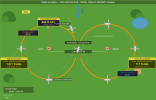
The issue is they left the old Graphic shown below which if you fly it like this you probably have a 10 to 15 second straight line.

So the question is, what is your DPE expecting it to look? like the image below or like what the text describes? and I have created below.
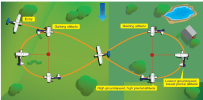
1774981285151.png


Today I decided to see if AI and I could come up with what the manuveur actually looks like when you shorten the straight section and apply the affect of about 10kts of wind.
It took a an absurd amount of negotiating with AI to get a descent graphic. Like trying to get 3rd grader that is really good and math and art, but horrible at logic or understanding the concept to draw it for me.

Here is what we ended up with..
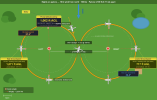
1774985107257.png

Brian
CFIIG/ASEL
 

Attachments

  • 1774983808022.png
    1774983808022.png
    272.8 KB · Views: 27
Last edited:
It's probably just me, but t he first photo look more like 3-5 seconds of straight and level flight than the second. The second looks more like linked steep turns where you rollout from the first and bank immediately into the second with exactly zero seconds straight ad level.
 
Fly the standard, not ANY picture.
 
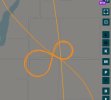
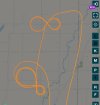
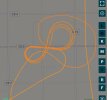
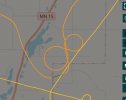
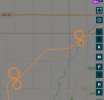
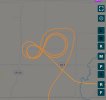
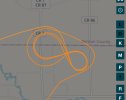
You piqued my curiosity, I did some digging. One of these was a checkride pass.
 

Attachments

  • IMG_6429.jpeg
    IMG_6429.jpeg
    94.3 KB · Views: 21
  • IMG_6428.jpeg
    IMG_6428.jpeg
    126 KB · Views: 21
  • IMG_6424.jpeg
    IMG_6424.jpeg
    123 KB · Views: 22
  • IMG_6423.jpeg
    IMG_6423.jpeg
    85 KB · Views: 22
  • IMG_6426.jpeg
    IMG_6426.jpeg
    107.5 KB · Views: 22
  • IMG_6427.jpeg
    IMG_6427.jpeg
    103.9 KB · Views: 22
  • IMG_6425.jpeg
    IMG_6425.jpeg
    99.1 KB · Views: 20
  • IMG_6430.jpeg
    IMG_6430.jpeg
    110.3 KB · Views: 21
...and considered flying pipeline patrol in Oklahoma. :rofl:
That's a great book! Definitely on my shelf. Ironically, I found wheel landings to be easier than three-point landings. Much more confidence inspiring, especially with any kind of crosswind.
 
It's probably just me, but t he first photo look more like 3-5 seconds of straight and level flight than the second. The second looks more like linked steep turns where you rollout from the first and bank immediately into the second with exactly zero seconds straight ad level.
Which is fine. 3-5 seconds is the maximum time to be wings level between the first and second pylon. Beginning the second pylon immediately isn’t wrong, it’s just not easily achieved often times.
 
Which is fine. 3-5 seconds is the maximum time to be wings level between the first and second pylon. Beginning the second pylon immediately isn’t wrong, it’s just not easily achieved often times.
Yes, but I wouldn’t want someone training to think it has to be immediate. I can ‘intuitively” see the FAA diagram Is not to scale. I can’t tell that with the mod.
 
I'd like to see the AI fly the transition from its entry into the figure-8 pattern. From the ground, not while onboard.
 
It's probably just me, but t he first photo look more like 3-5 seconds of straight and level flight than the second. The second looks more like linked steep turns where you rollout from the first and bank immediately into the second with exactly zero seconds straight ad level.
it is pretty simple math, if you look at the 1st image it is mostly a straight line from top of one turn to the bottom of the other, just a bit more than a 180 degree turn. if the points are 3/4 of a mile apart, let say the straight section is a 1/2 mile long. even at 120kts that is going to take 15 seconds. (120kt = 2 miles per minute)

Brian
 
the examiner will probably just be thrilled if you don't use rudder to hold the point and more or less maintain pivotal altitude...
 
Ground Ref. point moving back, needs yoke back pressure. Ground ref. point moving forward, a little forward yoke pressure. "Ball in the center!".
 
And this is what the DPE will be concentrating on during the maneuver:

IMG_4251.gif
 
it is pretty simple math, if you look at the 1st image it is mostly a straight line from top of one turn to the bottom of the other, just a bit more than a 180 degree turn. if the points are 3/4 of a mile apart, let say the straight section is a 1/2 mile long. even at 120kts that is going to take 15 seconds. (120kt = 2 miles per minute)

Brian
I think we just looking at and for two different things. You want to see a mathematically accurate to-scale depiction even if the straight and level portion ends up invisible due to the overall size of the graphic. I’m more interested in a not-to-scale visual depiction of a concept.

So, even if your picture accurately reflects going to straight and level, then flying 3-5 seconds, then rolling into another turn, it would not be help me understand the maneuver. The FAA ‘s does. Some else’s take might be different.

I see the same differences in the way people view other maneuvers too.
 
Back
Top