Engine wasn’t broken in with mineral oil, how shafted are we?

Philip98

Filing Flight Plan
Joined
Mar 12, 2025
Messages
16
Display Name
Philip98
Mechanic putting a field overhauled engine on a shared plane didn’t put mineral oil in (because he didn’t have any, idk why he didn’t just order some, we would have paid for it and gladly waited…) and he told us that it was fine with "modern" oils (I am pretty sure aviation oil hasn’t changed in decades) and we believed him. I suspect this was bad idea. Engine now has 150 hours on it.

Engine is a Lycoming O-540

Basically, how shafted are we?
 
So what did he put in instead of mineral oil. What symptoms are you seeing that leads you to believe the cylinders did not break in properly?
 
So what did he put in instead of mineral oil. What symptoms are you seeing that leads you to believe the cylinders did not break in properly?
He put Aeroshell W100 plus in. The symptom we are seeing is no drop in oil consumption. The plane has been burning about 1/4th to 1/2 quarts per hour. One cylinder is also colder by about 50 degrees than the others. We have been unable to find any obvious source of oil leakage on the engine. Sorry, slipped my mind to include this information on the initial post. About to board a flight home from Japan, a little scattered brained at the moment.
 
What is your oil consumption? If normal, then you are not screwed at all. If you are burning too much oil, then the break in failed, but there are corrective actions for that.
 
What is your oil consumption? If normal, then you are not screwed at all. If you are burning too much oil, then the break in failed, but there are corrective actions for that.
Burning about 1/4th to 1/2 quarts per hour.
 
Sounds to me like you will need to pull the jugs, hone the cylinders, install new rings, and do a proper break-in on the engine.

What does a borescope of the cylinders reveal (see the link in post #4)?
 
Did it burn this much oil from the beginning right after the overhaul break in, or just recently started? The rings either set correctly or they didn't after the first 3-5 hours.

For context, the nice Continental folks as the Oshkosh tent told me that for a Continental 1 quart in 5 hours is about right.

Some modern ashless dispersion oils can be used for break in as long as they don't contain antiwear additives (Aeroshell 100 W Plus has those additives).
 
Last edited:
1/4th quart per hour doesn't sound too bad, esp on an o-540. as others have said, i'd just borescope the cylinders to get an idea if it worked or not.
 
Yeah, you’ll want to pull the jugs to re-hone and replace with new rings, then run the snot out of it at high power with the proper oil. The mechanic should have known better.
 
Yeah, you’ll want to pull the jugs to re-hone and replace with new rings, then run the snot out of it at high power with the proper oil. The mechanic should have known better.

Yep. As I noted in post # 10, I believe this is what is needed. I had a VW aero-engine conversion many years ago that I bought from a builder. It was new but ran poorly as it had issues by being set up incorrectly (timing was off but he didn't discover it).

He had done a lot of ground running trying to diagnose the problem. I found the problem and fixed it but the engine consumed a lot of oil and after changing the oil it would turn dark quickly ...
 
Yeah, you’ll want to pull the jugs to re-hone and replace with new rings, then run the snot out of it at high power with the proper oil. The mechanic should have known better.
Not until you determine if its required. Boroscope the engine first. Typically there is no set time but you go until oil consumption lowers and stabilizes.

Lycoming SB 1427C:

The following formula is used to calculate the maximum allowable oil consumption limits for all
Lycoming aircraft engines.

0.006 x BHP x 4 ÷ 7.4 = Qt./Hr

A 230hp o-540 is .74qt/hr
A 300hp o-540 is .97gq/hr

OP is saying .25qt/hr - .5qt/hr.

Not seeing a problem here. Can the engine make rated RPM? As for the 'cold' cylinder that's a completely different issue. For example what type of probe? What kind of monitor? etc

The straight mineral/vs AD oil is a whole 'nutter debate
 
Last edited:
Yeah, you’ll want to pull the jugs to re-hone and replace with new rings...
Yep. As I noted in post # 10, I believe this is what is needed.
I agree the engine should have been broken in with straight mineral oil, but if the oil consumption is within spec why on earth would you tear it apart?
I found the problem and fixed it but the engine consumed a lot of oil...
Is 1 quart every 4 hours excessive? Is the OP counting blowing a bunch out of the breather in his consumption estimate? Too many open questions to start pulling things apart.

Nauga,
who has only broken in two sets of cylinders
 
How much oil was put in to begin with? Lots of aircraft engines like to blow out oil above a certain amount.
Second, how did you fly the engine to break it in? If you babied it, you can fail to seat the rings, causing excess oil consumption.
Neither of these have anything to do with the oil type, but the stuff your mech used was not the best for break in.
 
The plane has been burning about 1/4th to 1/2 quarts per hour.

Take the high / hour, thats 2.5 (almost 3) quarts every 5 hours. That’s too much IMHO.

Bore scope, do the oil pooling in cylinder test, etc.

It should be fixed.

Edited because I didn’t originally do the math right.
 
Last edited:
Not until you determine if its required. Boroscope the engine first. Typically there is no set time but you go until oil consumption lowers and stabilizes.

Lycoming SB 1427C:

The following formula is used to calculate the maximum allowable oil consumption limits for all
Lycoming aircraft engines.

0.006 x BHP x 4 ÷ 7.4 = Qt./Hr

A 230hp o-540 is .74qt/hr
A 300hp o-540 is .97gq/hr

OP is saying .25qt/hr - .5qt/hr.

Not seeing a problem here. Can the engine make rated RPM? As for the 'cold' cylinder that's a completely different issue. For example what type of probe? What kind of monitor? etc

The straight mineral/vs AD oil is a whole 'nutter debate
I agree the engine should have been broken in with straight mineral oil, but if the oil consumption is within spec why on earth would you tear it apart?
I understand the manufacturer limits are quite high, but 1/2qt per hour is excessive for a 150hr engine. It might be “OK” for the time being, sure, but I would expect cylinder work to be in the near future. The cylinders were not broken in properly.
 
I wouldn’t do anything until it has been determined that something is wrong. There is not enough evidence in this thread to make a decision on anything.

Discuss this with the engine shop and decide how to proceed from there. Also worth noting, Lycoming calls for break in with AD oils for some applications. Yours may not be one they call for that on but I consider that as evidence that they can (eventually) break in satisfactorily with any of the common oils. I’ve tried a bunch of different oils during the break in of personal engines and haven’t found the results to vary much.
 
I agree that the oil consumption is high for such a fresh engine, but it is within spec, and you can induce other failures when pulling and reworking a jug. Personally, I think I’d just fly the stew out of it, monitor the oil consumption, and wait until some other issue compelled me to pull a cylinder and then address it at that time. Don’t add risk trying to turn acceptable performance into ideal performance.
 
...1/2qt per hour is excessive for a 150hr engine.
Depends on which hour you're talking about. If it's in the first hour after filling to the brim it's normal. If it's *every* hour then it might be a problem.
If it's closer to the 1/4 quart per hour end if the range given it might be bounding.

Nauga,
and a heavy breather
 
Burning about 1/4th to 1/2 quarts per hour.

Half quart an hour on a low time engine would bother me. But that's based on my Lycoming 4 banger. Do you know anyone else with a Conti 540 to compare data with?

I would try to verify that burn rate with more precision, then have a conversation with the shop that did the break in.
 
You can't do that "experiment" with a topped off Lyco. You'll GIGO the results because as was highlighted already, they vomit the first 1/2 thru 1 quart overboard on takeoff and climbout. 'trust me bro' is demonstrably cheaper in this case....trust me, bro. :biggrin:
 
Do overhaulers give a set oil burn rate as warranties? I’ve never seen it.

My O-470U had a permissible burn rate of at least a Quart per hour I believe
 
He put Aeroshell W100 plus in. The symptom we are seeing is no drop in oil consumption. The plane has been burning about 1/4th to 1/2 quarts per hour. One cylinder is also colder by about 50 degrees than the others. We have been unable to find any obvious source of oil leakage on the engine.
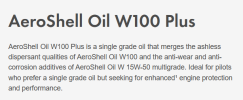
From the Aeroshell website:

1763836497327.png

That anti-wear additive really cuts the friction and will definitely hamper break-in. When I switched to using it in may ancient A-65, the oil temps dropped about 30 degrees. It's that slick. That additive is AD-mandated for the O-320-H2AD engines that had so much cam and lifter trouble.
For context, the nice Continental folks as the Oshkosh tent told me that for a Continental 1 quart in 5 hours is about right.
Yeah, and they're the same folks that tell you that compressions as low as 43/80 are fine, too. That's a common number if you do the orifice calibration before doing the compressions, in accordance with https://www.aircraftspruce.com/catalog/pdf/servicebulletin.pdf
Not until you determine if its required. Boroscope the engine first. Typically there is no set time but you go until oil consumption lowers and stabilizes.
"Not until you determine if it's required?" It's required. See https://www.lycoming.com/sites/default/files/attachments/Lycoming%20Reciprocating%20engine%20Break-In%20and%20Oil%20Consumption.pdf

From that:

1763837103703.png

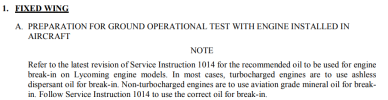
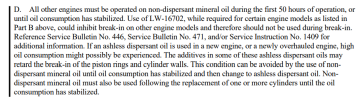
And from Lycoming SI 1014: https://www.lycoming.com/sites/default/files/attachments/SI1014N%20Lubricating%20Oil%20Recommendations.pdf We get:

1763837414088.png

That LW 16702 additive is the stuff found in W100 Plus and Aeroshell 15W50.

Not seeing a problem here.

You wouldn't. Knowledge is required to see a problem.
 
Last edited:
I agree the engine should have been broken in with straight mineral oil, but if the oil consumption is within spec why on earth would you tear it apart?

Is 1 quart every 4 hours excessive? Is the OP counting blowing a bunch out of the breather in his consumption estimate? Too many open questions to start pulling things apart.

Nauga,
who has only broken in two sets of cylinders

It's just my $00.02 and what I would likely do if a borescope confirmed what seems likely. After spending good money I'd be disappointed with an engine with that much oil consumption after 150 hours (OP noted up to 1/2 quart per hour in post # 9).

Perhaps I'm just spoiled as my auto converted, air-cooled aircraft engine uses very close to zero oil in the 25-30 hours between changes.

Dale,
who has low tolerance for high consumers
 
Could he put mineral oil in now and go beat on it like a red headed step child??
 
Not until you determine if its required. Boroscope the engine first. Typically there is no set time but you go until oil consumption lowers and stabilizes.

Lycoming SB 1427C:

The following formula is used to calculate the maximum allowable oil consumption limits for all
Lycoming aircraft engines.

0.006 x BHP x 4 ÷ 7.4 = Qt./Hr

A 230hp o-540 is .74qt/hr
A 300hp o-540 is .97gq/hr

OP is saying .25qt/hr - .5qt/hr.

Not seeing a problem here. Can the engine make rated RPM? As for the 'cold' cylinder that's a completely different issue. For example what type of probe? What kind of monitor? etc

The straight mineral/vs AD oil is a whole 'nutter debate
Except those number are max power. You calculate based on what power settings you were using.
 
why not trust the mechanic? why jump to automatically thinking you're screwed? I'd worry about it in 2000 hours or so
There is incompetence in any field, and there are incompetent mechanics. We hear about them often enough on POA.
 
Going through a similar situation of oil use. But the engine is at 1,000 hours. Owner isn't concerned. I am. He doesn't want to borrow my bore scope. "Old engines leak and burn oil". Yeah but.... 1/2qt an hour would make a mess in the cowl and it's all on the belly. I've got a scope and spark plug gaskets for him. But he doesn't want to "tear the engine apart" Oh well. Not my plane.

Curious... Is the oil being burned or is it blowing out the breather? What are you filling to?
 
Missing important information still. Did engine always burn this amount of oil after overhaul, or is this new?

Has oil burn rate been consistent since overhaul?
 
From the Aeroshell website:

View attachment 147415

That anti-wear additive really cuts the friction and will definitely hamper break-in. When I switched to using it in may ancient A-65, the oil temps dropped about 30 degrees. It's that slick. That additive is AD-mandated for the O-320-H2AD engines that had so much cam and lifter trouble.

Yeah, and they're the same folks that tell you that compressions as low as 43/80 are fine, too. That's a common number if you do the orifice calibration before doing the compressions, in accordance with https://www.aircraftspruce.com/catalog/pdf/servicebulletin.pdf

"Not until you determine if it's required?" It's required. See https://www.lycoming.com/sites/default/files/attachments/Lycoming%20Reciprocating%20engine%20Break-In%20and%20Oil%20Consumption.pdf

From that:

View attachment 147417

And from Lycoming SI 1014: https://www.lycoming.com/sites/default/files/attachments/SI1014N%20Lubricating%20Oil%20Recommendations.pdf We get:

View attachment 147418

That LW 16702 additive is the stuff found in W100 Plus and Aeroshell 15W50.


You wouldn't. Knowledge is required to see a problem.
You're completely glossing over the field overhaul spec. Lyc spec (aka thier own maths) say that OPs WELL WITHIN oil burn spec. They do say that to use mineral oil but they also say that if you don't, break in could take longer. Is it high? Maybe.

OP is also not being very specific.... a HALF QUART per hour variable is quite a large delta. Was the oil accurately measured when drained? ? How much oil is OP putting in? Is the motor being overfilled (say 12 qts) and then when it normalizes to 8-9qts its considered a problem? What are the current compressions? Improperly broke in rings/cylinders are not hard to find.

Unless there is oil on the bottom plug/in the cylinder there is nothing pointing directly to an oil control problem. OP hasn't give much other than a vague burn number.

The bottom line is that they engine is burning oil within spec. I hope OP also pulled plugs to look for oil and should also 'scope the engine. If the motor is making rated static RPM I don't see a problem worth taking off six jugs and introducing the possibility of even more issues.

No intellegent MX is gonna pop off cylinders and mess with through bolts unless there are clear signs of an actual issue. So far (due to OP's lack of feedback) there is nothing to show that there is a problem.

The fact that so many are wanting to attack a non-issue (from what we know so far) tells me that common sense ain't that common. If OP reports back with more clarifying data then sure, there may be another course... but after 100+ hours of flying and no reports of running rough (oil fouled plugs, not making rated RPM).

If your MX wants to rip into your motor becuase the owner THINKS oil consumption is high (although its not) then you need a new MX.
 
Take Grandpa's ashes and park them in front of the air intake and run the engine until Grandpa’s gone.
I've told this story on PoA before, but cannot resist telling it here, given direct reference. It is my favorite airplane story.

A close friend of mine bought a Cherokee 180. When he replaced the interior, the backside of the panels was nasty. Backstory from the previous owner:

One of his uncles passed away, and requested his ashes be scattered over Tampa Bay. He and his wife flew over the bay with the ashes in a bag. They opened the small side vent window and placed the mouth of the bag over it. The bag inflated, then exploded. Instant IMC in the cockpit, everyone gagging, ashes in their eyes, mouth, hair, etc.
 
Back
Top